Welcome to DSPy: A Practical Guide
A comprehensive journey from prompt engineering to prompt programming
The Challenge of Traditional Prompt Engineering
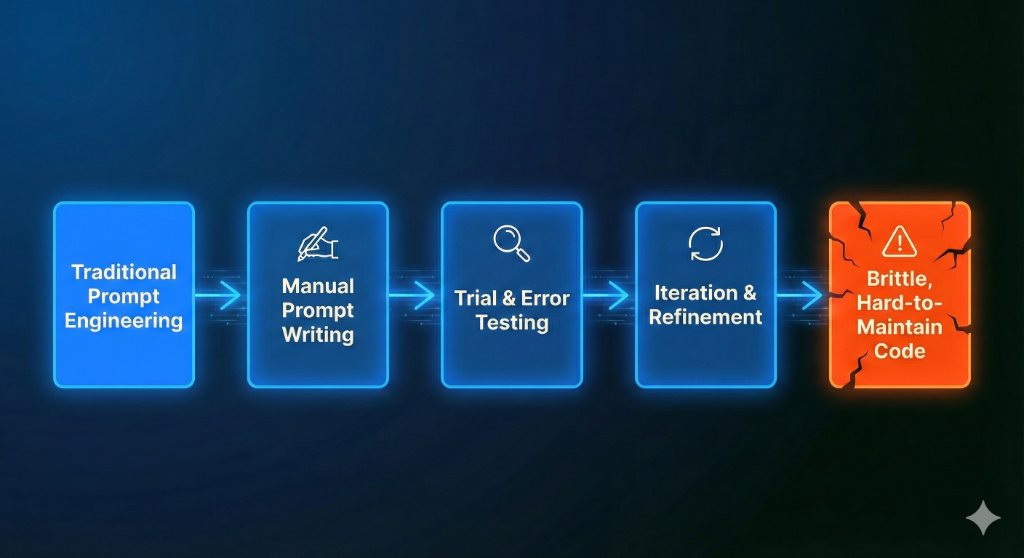
We have all been there. You discover the power of LLMs, and it feels like magic—at first. You write a prompt manually, and it works. But then you encounter an edge case.
As illustrated above, this kicks off a cycle of Manual Prompt Writing and endless Trial & Error. You tweak a word here, add a 'few-shot' example there, and test it against a handful of inputs. It seems to work, so you push it.
But this isn't engineering; it's guessing. The result is inevitably Brittle, Hard-to-Maintain Code. When the underlying model updates or your data shifts, your carefully crafted prompt breaks, leaving you with a fragile system that is impossible to scale.
Brittleness
Small changes break behavior
High ImpactScalability
Doesn't work for complex pipelines
High ImpactMaintainability
Hard to update and debug
High ImpactReproducibility
Inconsistent results across runs
High ImpactThe DSPy Paradigm Shift
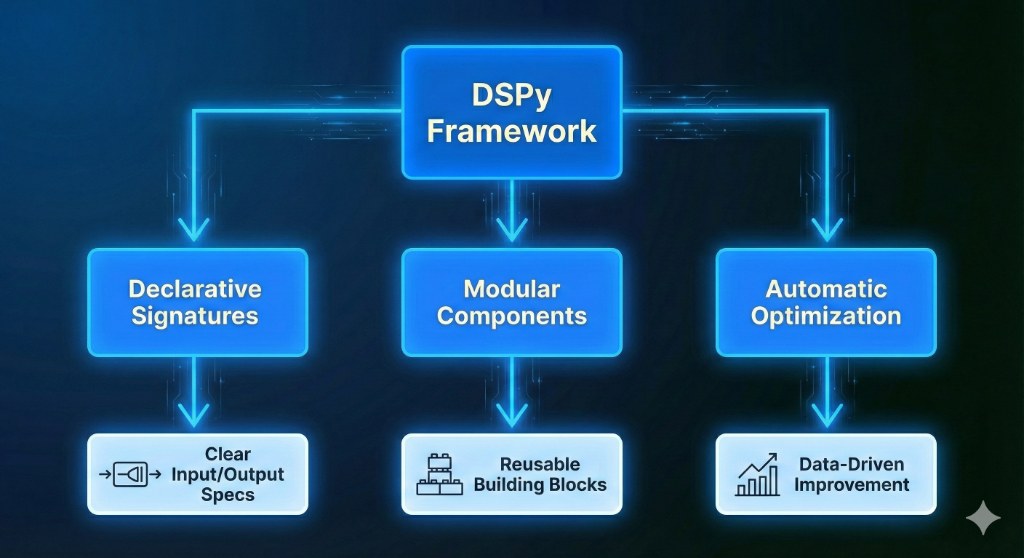
DSPy changes everything. Instead of manually tuning prompts, DSPy introduces a programming paradigm for LM-based applications. Think of it as the difference between:
prompt = "Summarize this text: {text}"
response = llm(prompt)class Summarize(dspy.Signature):
"""Summarize a given text."""
text = dspy.InputField()
summary = dspy.OutputField()
summarizer = dspy.ChainOfThought(Summarize)Notice the fundamental difference in data types. The Traditional Approach relies on 'string concatenation'—stuffing variables into a sentence and hoping the LLM understands. It is fragile and hard to test.
In contrast, the DSPy Approach treats the LLM interaction as a Function. By defining a
classwith clearInputFieldandOutputField, you separate what you want (the signature) from how the prompt is written. This allows DSPy to automatically optimize the prompt in the background while your code remains clean and typed.
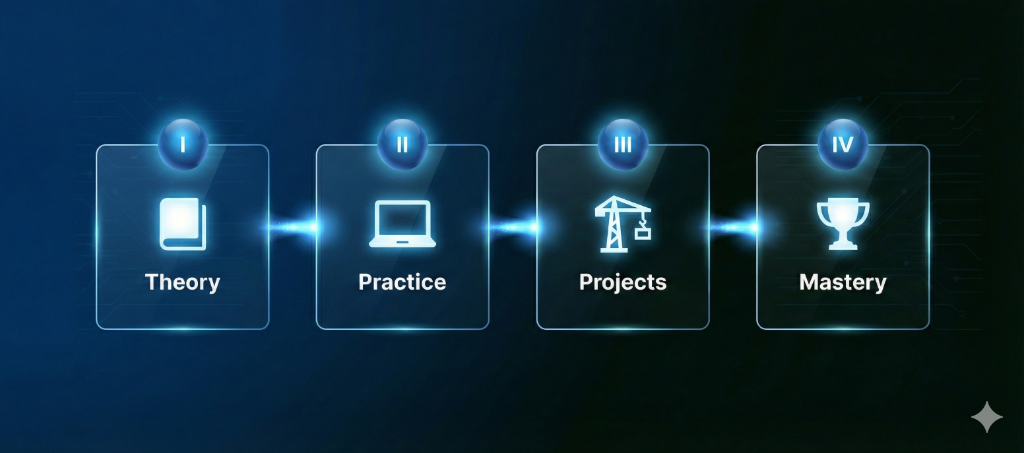
The Learning Journey
Who This Book Is For
Complete Beginners
- New to DSPy and want to learn from scratch?
- Understand Python basics but haven't worked extensively with LLMs?
- Want a step-by-step guide with clear explanations?
Intermediate Developers
- Worked with LLMs and prompt engineering before?
- Understand the basics of AI/ML concepts?
- Want to learn DSPy's framework for robust applications?
Advanced Practitioners
- Already familiar with DSPy's basic concepts?
- Want to learn optimization techniques and production patterns?
- Looking for real-world case studies and advanced applications?
Regardless of your level, this book provides multiple reading paths so you can start at the right place and progress at your own pace.
Acknowledgments
This book stands on the shoulders of giants. Special thanks to:
- The DSPy Team at Stanford NLP for creating this revolutionary framework
- Omar Khattab and contributors for their dedication and vision
- The Community for feedback, examples, and enthusiasm
- Early Readers for their valuable insights and suggestions
Dustin Ober
December 2025
Credits & Licensing
Code Attribution: Code examples and technical concepts in this ebook are adapted from the official DSPy repository and documentation, licensed under the MIT License.
Asset Attribution: The DSPy name and logo are property of their respective owners. This ebook is an independent community project and is not officially affiliated with the DSPy development team. All illustrative images and diagrams within this ebook were created with the assistance of Google Gemini.